Avidclan Technologies
The software architectures of the modern world are changing from monolithic applications to microservices and distributed ecosystems. Such transformation enables the organizations to be able to deploy faster, scale independently, and develop with modularity across business functions. Nevertheless, testing has become complicated due to the fact that systems are no longer single entities. A variety of independently deployed and loosely coupled services are to interact perfectly with APIs, messaging layers, workflow events, and cloud infrastructure.
Quality assurance in microservices environments should have a customized methodology that will consider reliability, communication dependencies, service contracts, data synchronization, performance, and resilience to load in a real-world environment. The implementation of the correct test strategy requires the adoption of automation, observability, environment orchestration, and failure simulation so that there is consistent behavior of the system between distributed components.
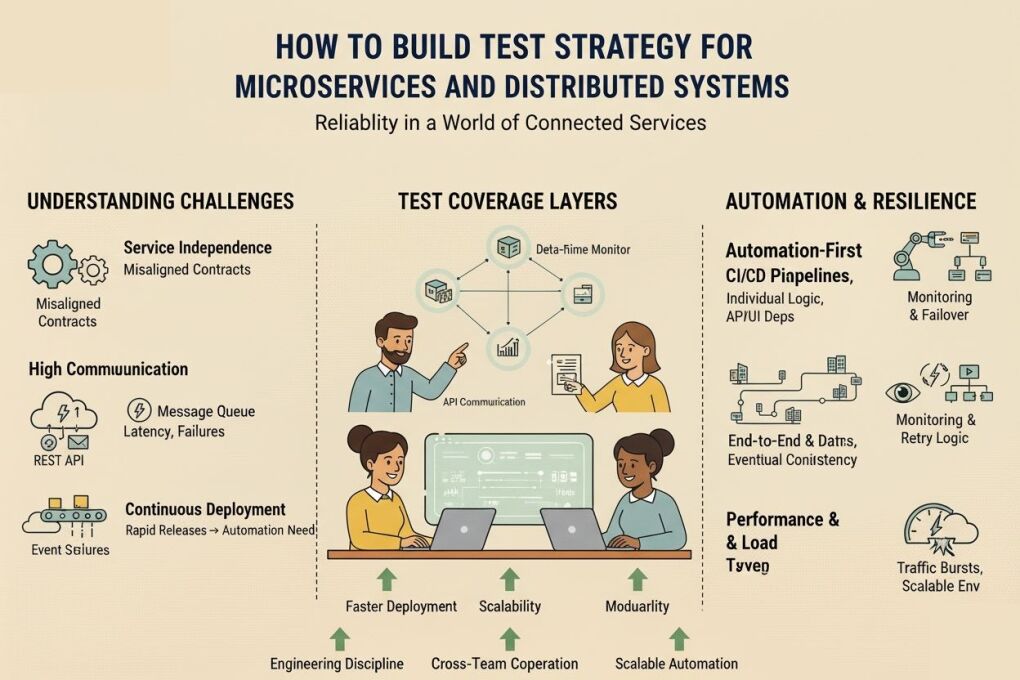
Understanding Testing Challenges in Microservices Architecture
Service Independence and Shared Responsibility
Service Independence and Shared Responsibility
Each service has its own logic, data storage, deployments, and teams. While independence accelerates development, it also increases the risk of misaligned communication contracts. Services may function individually but fail when integrated. Teams need a robust quality framework that validates integration flows rather than only unit-level logic.
High Number of Communication Points
Microservices interact through REST APIs, gRPC, message queues, and event streams. These cause situations like network latencies, partial failures, payload mismatch, and idempotency errors. Realistic testing must replicate service discovery, distributed communication, and cloud orchestration behaviors.
Continuous deployment pressure
Rapid releases mean testing must keep pace with development velocity. This shifts traditional scripting and framework setup toward modern automation capabilities, including professional API automation testing services that support scalable test coverage across CI/CD pipelines.
Defining Test Coverage Layers for Distributed Systems
Unit and Component Testing
Unit and Component Testing
Individual service logic must be validated independently with mock dependencies and simulated data. Since microservices are owned by isolated teams, proper versioning and contract mapping are essential to avoid downstream issues.
Contract and integration testing
Testing communication formats ensures that producers and consumers remain compatible even when deployed separately. Schema-based contracts, consumer-driven pact testing, and automated validation workflows ensure stable interaction patterns, commonly supported through enterprise-grade microservices testing services for distributed validation.
End-to-End and Data Consistency Validation
End-to-end scenarios verify business outcomes across multiple services. In distributed ecosystems, data consistency is maintained using eventual consistency models, event sourcing, and distributed transactions. Teams must test real-world outcomes, not only internal interactions, using environmental replicas whenever possible.
Automation, Tooling, and Resilience Testing
Automation-First Testing Model
Automation-First Testing Model
Microservices require continuous validation across updates and dependency changes. Teams rely on automation frameworks designed for distributed orchestration and real-time execution pipelines. Organizations often collaborate with specialists in areas such as Selenium automation testing services when UI-level validation is required on top of service automation.
Where high-scale test engineering is essential, teams may seek dedicated expertise through partnerships that enable professional delivery, similar to engagement models where companies hire QA engineers for long-term automation maturity.
Monitoring, observability, and failover
Microservices interact through REST APIs, gRPC, message queues, and event streams. These cause situations like network latencies, partial failures, payload mismatches, and idempotency errors. Testers should analyze latency, retry logic, timeout strategies, and fallback mechanisms across services.
Performance and Load Evaluation
Testing must account for unpredictable traffic burst patterns and container lifecycle behaviors. Scalable cloud test environments, autoscaling metrics, and network-level resilience are essential for production-grade confidence.
Team Model, Collaboration, and Skill Structure
Testing Skill Distribution
Testing Skill Distribution
A microservices testing team requires multiple competencies, including scripting, API validation, performance testing, DevOps automation, and containerization. Many organizations strengthen internal capability through support models such as hiring test automation experts for specialized delivery or integration into DevOps testing pipelines.
For UI automation within the microservices ecosystem, teams may extend framework development using engineering expertise similar to collaboration models where companies hire Selenium developers to build reusable automation layers for modular components.
For globally distributed delivery, enterprises may engage remote professionals based on flexible operating models, as seen when they hire remote developers for continuous development and maintenance cycles.
Centralized Quality Governance
While microservices promote decentralization, testing governance should not be fragmented. Shared standards, documentation templates, versioning rules, and observability frameworks allow consistency across distributed systems.
Organizations that require wider scope testing, including integration and regression, rely on structured capability models similar to professional Selenium testing services for web automation management aligned to domain-specific test maturity levels.
Conclusion
A strong test strategy in microservices and distributed systems cannot be built using traditional QA planning. It requires multi-layer validation, contract-based testing, service-level observability, fault-tolerance testing, and automation to be built into DevOps pipelines. The most reliable model of testing is a hybrid approach of testing individual components and business processes.
The success of microservices testing relies on engineering discipline, cross-team cooperation, and scalable automation. Enterprise teams, which match testing structures to architectural objectives, deliver products faster, have more robust systems, and have less downtime. In scenarios where internal capabilities require additional engineering depth, organizations may collaborate with service-driven partners offering enterprise solutions such as Selenium testing services aligned to digital product delivery.
Kommentare
Verantwortlich für den Inhalt dieser Seite ist ausschließlich der
Autor dieser Homepage, kontaktierbar über dieses Formular!